

Two ecommerce brands can post the same revenue and the same profit, and the one with a large, engaged, transferable email list will sell for a higher multiple almost every time. The reason is risk again, but in reverse. A buyer pricing your business is trying to figure out how much of next year’s revenue is guaranteed before they spend a dollar on ads, and an owned audience is the closest thing in ecommerce to guaranteed demand. The challenge is that most founders treat the list as a marketing tool rather than a balance-sheet asset, and they never assemble the proof a buyer needs to pay for it. This guide breaks down how email list valuation actually works in an ecommerce sale, how buyers price owned audience, and what you have to document to turn your subscribers into a number on the deal.
This article is written for DTC and Shopify founders preparing to sell who want to understand how their email list, SMS list, and broader owned audience affect the price. It covers why owned channels carry valuation weight, how buyers translate audience into multiple, the metrics they scrutinize, what destroys list value, and the documentation that makes the audience transferable. None of this is financial advice. Use it to build a cleaner story and to ask your advisor and accountant sharper questions before you go to market.
Why Owned Audience Carries Valuation Weight
Every ecommerce business runs on demand, and demand comes from somewhere. The whole question a buyer is trying to answer is how durable and how expensive that demand is, because the revenue they are buying only continues if the demand continues. An owned audience, the email and SMS subscribers you can reach for free whenever you want, is the most durable and least expensive demand source a brand can have, and that is exactly why buyers assign it real value.
Think about the difference from the buyer’s seat. A brand that acquires every sale through paid ads is renting its demand. The moment the ad budget stops or the platform costs climb, revenue falls, and the buyer has to keep feeding the machine to stand still. A brand with a large engaged list owns a slice of its demand outright. It can launch a product, recover a slow month, or absorb a rise in ad costs by sending a campaign that costs almost nothing. That optionality is worth money, and a disciplined buyer prices it in.
The list also de-risks the single biggest fear in any acquisition: that customer acquisition cost rises after the deal and crushes the margin the buyer paid for. An owned audience is a built-in hedge against that fear. The bigger and more engaged the list, the more of the brand’s future revenue is insulated from the ad auction, and the more confident the buyer can be that the earnings survive their ownership.
What a buyer is really valuing when they look at your owned audience:
- The share of revenue that comes from email and SMS rather than paid ads
- The size of the list relative to the brand’s revenue and order volume
- How engaged the audience is, measured by opens, clicks, and repeat orders
- Whether the audience transfers cleanly and legally to a new owner
- How much the list reduces the brand’s dependence on paid acquisition
The most common framing mistake: treating your email list as a marketing channel instead of a transferable asset. Buyers do not pay for a list because it is large. They pay because it lowers the risk and cost of the revenue they are acquiring. If you cannot connect your list to revenue and durability, it reads as a vanity number and adds nothing to the price.
For the wider picture of which factors move a direct-to-consumer multiple and where owned audience sits among them, DTC Brand Valuation 2026 walks through the full set of drivers and pairs directly with the audience lens in this article.
How Buyers Translate Audience Into Multiple
A buyer does not add a separate line item for your email list, multiply it, and bolt it onto the price. The list works through the multiple, by changing how the buyer perceives the quality and durability of the earnings they are already paying for. A brand with a strong owned audience gets a higher multiple on the same seller’s discretionary earnings, because the buyer trusts those earnings more and sees a cheaper path to growing them.
The mechanism is the revenue mix. When a buyer sees that a meaningful share of orders comes from email and SMS, they read the brand as less fragile and less ad-dependent, and they apply less of a risk discount to the multiple. When nearly all revenue traces back to paid acquisition, the buyer sees a brand that has to buy every customer, and the multiple compresses to reflect the cost and volatility of that dependence. Two identical profit figures can earn very different multiples on the strength of where the demand comes from.
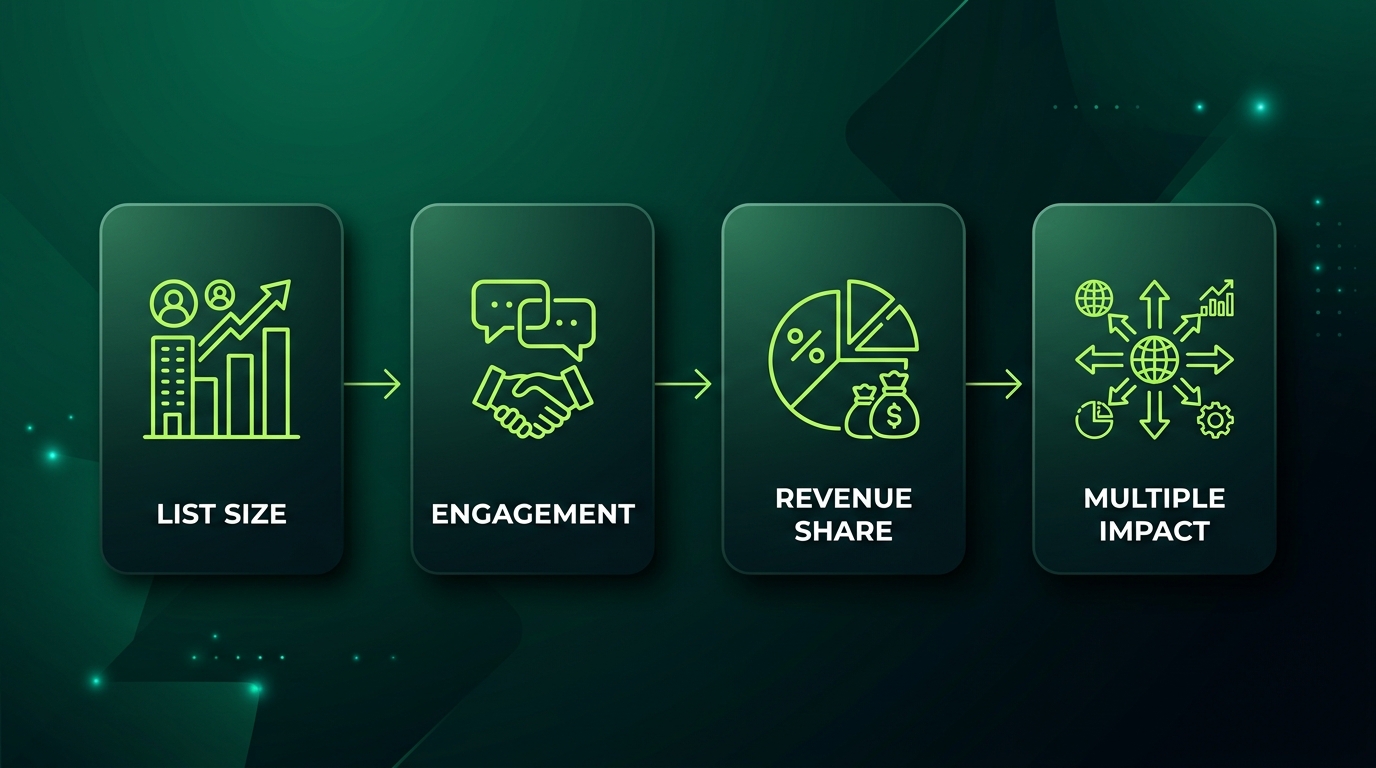
The practical takeaway is that an owned audience is one of the few valuation levers you can build before you sell. You cannot manufacture two extra years of profit in a quarter, but you can grow the list, raise its engagement, and shift a larger share of revenue onto owned channels, and each of those moves pushes the multiple in your favor. The list is leverage you control.
What pushes the multiple up or down through your owned audience:
- A high share of revenue from email and SMS pushes it up
- Strong, stable engagement and repeat purchasing pushes it up
- A list growing faster than the brand’s customer base pushes it up
- A list that is large but unengaged or dormant adds little
- Heavy reliance on paid ads with a thin owned channel pushes it down
- A list with consent or transfer problems can pull value out entirely
The most common pricing mistake: assuming a big subscriber count automatically raises your multiple. Buyers discount the headline number fast and look straight at engagement and revenue contribution. A hundred thousand subscribers who never open an email move the multiple less than ten thousand who buy every launch. Size without engagement is noise.
To see how the base multiple itself is set in the current market before owned audience adjusts it, Ecommerce Multiples in 2026 explains what moves the figure and gives you the baseline this article builds from.
The Metrics Buyers Examine in Your List
Once a buyer accepts that your owned audience matters, they stop taking your word for it and start measuring. A founder will describe the list as engaged and valuable. A buyer wants the data that proves it, and they know which metrics separate a real asset from a number in a dashboard. Coming to the table with these figures already assembled signals that you understand what you are selling.
The first thing a buyer measures is engagement, not size. Open rates, click rates, and the trend in both over the past year tell them whether the audience is alive and paying attention or quietly decaying. The second is revenue contribution: what percentage of total revenue email and SMS drive, broken out by campaigns and automated flows. The third is list health over time, whether the list is growing, the rate of new subscribers, and how fast subscribers go dormant or unsubscribe. Together these answer whether the asset is appreciating or eroding.
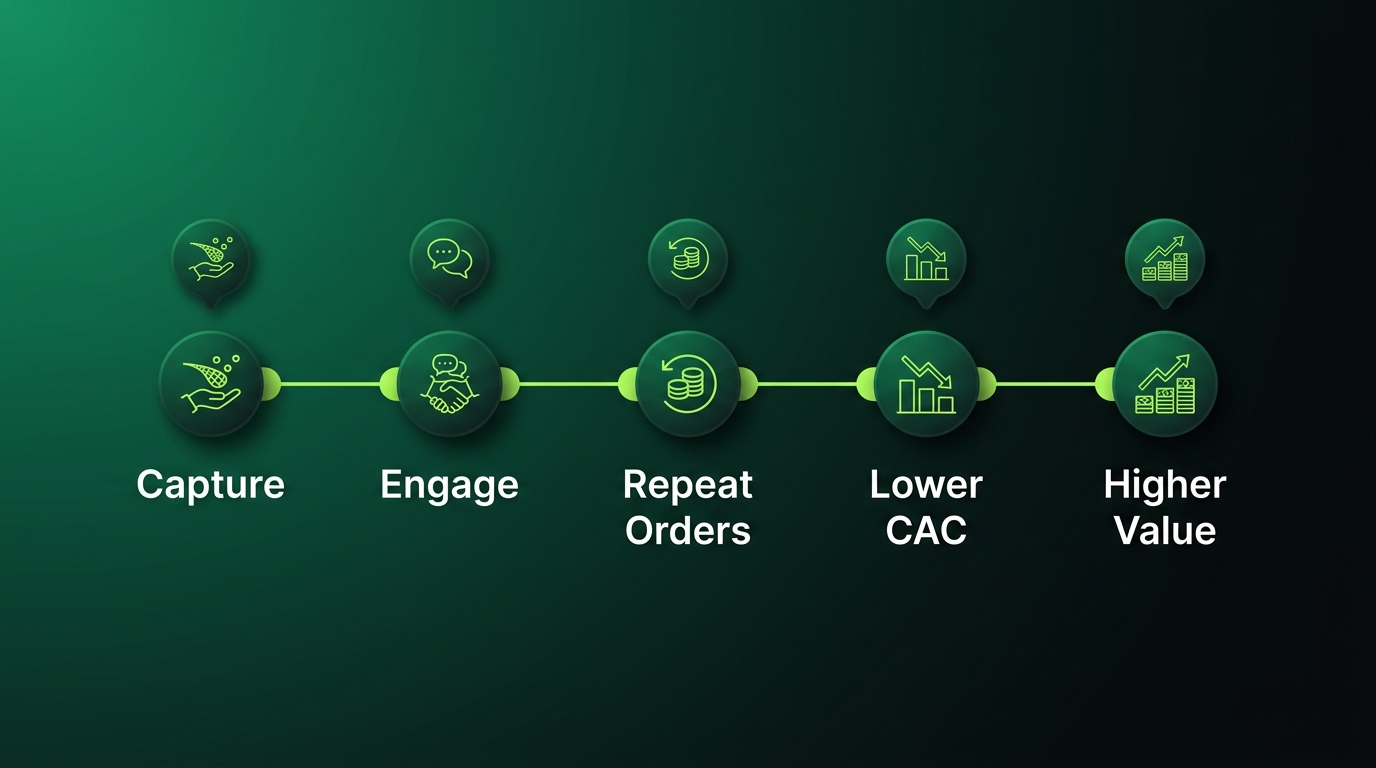
Buyers also look at the economics underneath the list. A healthy owned channel shows up in a lower blended customer acquisition cost, a higher repeat-purchase rate, and a higher lifetime value than a comparable ad-dependent brand. Those downstream numbers are the proof that the list is doing real work, and they are harder to fake than a subscriber count, which is exactly why buyers trust them.
What buyers examine in an owned audience:
- Active subscriber count, not the raw total including dormant addresses
- Open rate, click rate, and the twelve-month trend in each
- Revenue from email and SMS as a share of total revenue
- The split between automated flow revenue and one-time campaign revenue
- List growth rate, new subscriber sources, and dormancy or churn rate
- Downstream effects on acquisition cost, repeat rate, and lifetime value
The most common metrics mistake: presenting the total subscriber number and nothing else. The total is the least informative figure you have, because it includes everyone who ever signed up and never engaged again. Lead with active subscribers, engagement trends, and revenue contribution, or the buyer will assume the list is mostly dead weight and price it that way.
Owned Versus Rented: Why Email and SMS Win
Not all audiences are created equal in a sale, and the distinction that matters most is ownership. An email or SMS list is an owned audience: you hold the contact information, you can reach those people directly, and you can hand that ability to a buyer at close. A social media following is a rented audience: it lives on a platform you do not control, the platform decides who sees your posts, and the relationship can change overnight with an algorithm tweak or an account issue. Buyers know the difference and price it sharply.
This is why a brand with a modest but engaged email list often gets more valuation credit for its audience than a brand with a large social following and no owned channel. The email list comes with the deal in a way the followers do not. A buyer can take ownership of the sending platform, keep mailing the list, and continue driving revenue from day one. A social following, by contrast, often depends on the founder’s personal presence, their face, and their voice, and much of it can evaporate when they leave.
That does not make social worthless. A strong following can feed the top of the funnel and convert into owned subscribers, and a brand that has built genuine community has something real. But in the valuation conversation, the buyer separates what transfers from what walks out the door with the founder, and the owned channels are what they will actually pay a premium for.
What separates owned audience from rented audience in a sale:
- You hold email and SMS contact data and can transfer it at close
- Owned channels keep working regardless of platform algorithm changes
- Social followings often depend on the founder’s personal presence
- A platform can suspend or throttle a rented audience without warning
- Owned channels convert directly to revenue the buyer can model
- Followers add credibility but rarely transfer one to one to a new owner
The most common audience mistake: leaning on a large social following as the proof of brand strength while neglecting the owned list behind it. Buyers discount rented audiences heavily because they cannot be sure the audience stays after you go. The founders who get paid for their audience are the ones who converted that following into owned subscribers the buyer can keep.
The personal-brand risk runs deeper than the audience itself, because a brand that lives on the founder’s face is harder to hand off across the board. How to Increase Your Ecommerce Valuation Before Selling covers how to reduce founder dependence and build value the buyer can underwrite without you.
What Destroys the Value of a List
An owned audience can be a powerful asset, but it is fragile in specific ways, and a buyer’s diligence is designed to find the cracks. The fastest way to lose the valuation credit you expect is to bring a list to market that looks large on the surface and falls apart under scrutiny. Knowing what destroys list value lets you fix it before a buyer finds it rather than after.
The first killer is consent and compliance. If you cannot show that subscribers opted in properly and that your data practices comply with the rules that apply to your markets, the buyer faces legal risk in mailing the list, and a list they cannot safely use is worth little. The second killer is deliverability. A list with a poor sender reputation, high bounce rates, or spam complaints may not even reach inboxes, which means the revenue you attribute to it is at risk the moment the buyer takes over. The third is decay: a list padded with dormant, purchased, or scraped addresses inflates the count while dragging down every engagement metric and every deliverability signal.
The fourth killer is transferability. If the list lives in a tangle of personal accounts, third-party tools, or platforms tied to you personally, the mechanics of handing it over cleanly at close become a problem, and anything that complicates the transfer makes the buyer nervous. Each of these issues is fixable, but only if you find it first.
What erodes or destroys list value in diligence:
- Subscribers acquired without clear, documented opt-in consent
- Data practices that do not comply with the rules in your markets
- Poor deliverability from a damaged sender reputation or high bounces
- Dormant, purchased, or scraped addresses inflating the count
- A list locked in personal accounts or hard-to-transfer tools
- No clean record of how, when, and where subscribers joined
The most common list-killer mistake: inflating the subscriber count with addresses you never engage and assuming bigger looks better. The padding does the opposite. It lowers your open and click rates, threatens deliverability, and signals to the buyer that the asset is poorly maintained. A smaller clean list beats a large dirty one in every valuation conversation.
Making the Audience Transferable and Documented
A strong email list valuation is won in the preparation, not the negotiation, and for an owned audience the preparation has two jobs: prove the value and prove the transfer. Buyers will not pay a premium for an audience they cannot verify and cannot safely take ownership of, so your task before going to market is to assemble the evidence and clear the path for a clean handover at close.
Start with the proof of value. Pull the engagement trends, the revenue contribution by channel and by flow, the list growth and churn figures, and the downstream effects on acquisition cost and repeat rate. Tie each figure to a source in your email and analytics platforms so the buyer can confirm it in diligence rather than take it on faith. This is the same discipline that protects your earnings figure, and the audience data belongs in the same package. For how the underlying profit number is built and defended, How to Calculate SDE for Your Ecommerce Business (2026) walks through the calculation and the records a buyer expects.

Then clear the transfer. Confirm the list lives in platforms that can be assigned or transferred to a new owner, document the consent and opt-in records, and make sure the sending infrastructure, the flows, and the integrations are organized enough to hand over without losing performance. The smoother the handover looks, the more of the audience value survives into the final price, because the buyer is no longer pricing the risk that the list breaks when it changes hands.
What to prepare before you take the list to market:
- Engagement reports showing open, click, and revenue trends over time
- Revenue contribution from email and SMS, split by flows and campaigns
- List growth, source of new subscribers, and dormancy or churn data
- Documented opt-in consent and compliance records for your markets
- Confirmation that platforms and data can transfer to a new owner
- Organized flows, integrations, and sending setup ready for handover
The most common transfer mistake: assembling the audience proof and the consent records only after a buyer asks for them. Records built under deadline pressure look thin, and a buyer questioning whether the list can legally and cleanly transfer will discount it heavily. Build the file before you list, so diligence confirms the audience value instead of unwinding it.
Bottom Line
Your email list and owned audience are not a marketing footnote in a sale. They are an asset that changes the multiple, because they answer the buyer’s central question about whether the revenue they are paying for is durable and cheap to sustain. An engaged, transferable owned audience lowers the brand’s dependence on paid ads, hedges the risk of rising acquisition costs, and gives the buyer a head start on growth, and a disciplined buyer pays for all three through a higher multiple on the same earnings.
The founders who capture that value do the work before they list. They grow the list and raise its engagement rather than chasing a vanity count. They shift a larger share of revenue onto owned channels. They clean the dormant and non-consented addresses out, protect their deliverability, and organize the platforms so the audience transfers cleanly at close. Then they bring the engagement trends, the revenue contribution, and the consent records to the table so the buyer can verify the asset instead of discounting it.
Get that right and your owned audience stops being a number in a dashboard and starts being a line of argument for a higher price. Start by confirming how your category is valued in DTC Brand Valuation 2026, then map the moves that lift your number with How to Increase Your Ecommerce Valuation Before Selling before you take the business to market.