

Most ecommerce founders spend years building their business and a few weeks negotiating away a significant portion of its value. The negotiation phase of an ecommerce sale is where deals get made or quietly dismantled, where well-prepared sellers protect their multiple and where unprepared ones watch their asking price erode in real time. Understanding how to negotiate effectively is not about tactics in the abstract. It is about knowing what buyers are optimizing for, where leverage actually sits, and how to defend your position when the pressure is highest.
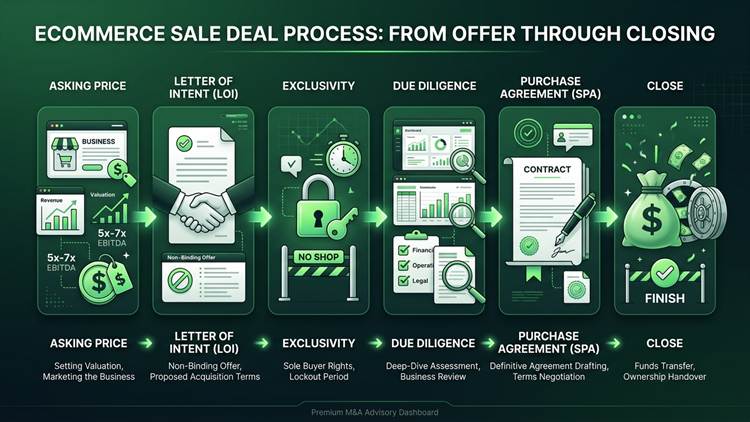
This guide covers the full negotiation arc: from setting your initial asking position, through the letter of intent, into due diligence, and all the way to the final purchase agreement. If you are still in the early stages of finding the right buyer, start with
How Ecommerce Deal Negotiations Differ from Traditional Business Sales
Negotiating an ecommerce sale is different from selling a traditional service business or retail operation in ways that matter for how you prepare. Because ecommerce businesses are data-intensive, most of the negotiation happens at two distinct moments: at the letter of intent stage (where headline economics are set) and during due diligence (where those economics get defended or quietly adjusted).
The most common mistake ecommerce sellers make is treating the LOI as the final negotiation. It is not. It is the beginning. Buyers who submit attractive LOIs often plan to use the due diligence process to surface issues that justify a price reduction. Sellers who understand this build their negotiation strategy around two parallel goals: getting the best LOI terms possible and then protecting those terms through a clean, well-documented diligence process.
A few dynamics that are specific to ecommerce deals:
- Revenue is verifiable in detail. Buyers will reconcile your Shopify data, payment processor statements, and bank deposits down to the dollar. Discrepancies get used as negotiating leverage. Accurate, reconciled financials are a negotiating asset.
- Multiples are sensitive to trend. A business with trailing twelve months trending up negotiates from a stronger position than one showing flat or declining months. Timing your go-to-market window matters more than most sellers realize.
- Platform dependency is a specific risk vector. Buyers who identify heavy concentration in a single channel (one paid platform, one supplier, one SKU) will use that concentration to push for price protection via earnouts or seller notes. If you can demonstrate channel diversification, you reduce their leverage.
- Digital asset ownership is frequently contested. Access credentials, social accounts, ad accounts, and domain ownership disputes create last-minute leverage situations. Having clean, documented ownership of every digital asset reduces the surface area for these disputes.
Setting Your Initial Asking Position
Your asking price sets the frame for everything that follows. Set it too low and you establish a ceiling that buyers will work down from. Set it too high without substantiation and you screen out credible buyers and create an adversarial tone before the first conversation. The goal is to anchor high but defensibly.
What strong sellers do before setting an asking price:
- Build a clean SDE calculation with every addback documented and sourced. Addbacks that cannot be defended get removed during negotiation, and each dollar removed at a 4x multiple costs four dollars at close.
- Calculate their trailing twelve months SDE and their prior twelve months SDE separately. If the business is growing, the trailing figure is more favorable and that is the one to lead with, with context.
- Research comparable deals in their category. Multiple ranges for DTC brands, Amazon FBA businesses, and subscription models differ meaningfully. Setting an asking multiple that is calibrated to recent comparable transactions makes the ask defensible.
- Build a simple model that shows what the business looks like for the buyer at the asking price. Strong cash-on-cash returns make a higher asking price easier to accept.
- Decide in advance what their walk-away position is. Sellers who have not thought through their minimum acceptable outcome are more likely to be moved under pressure.
The most common asking price mistake: stating a multiple without context. “I am asking 4x” is not an argument. “I am asking 4x on trailing twelve months SDE of $850K, supported by 28% YoY growth, a 45% repeat purchase rate, and a Klaviyo list of 62,000 active subscribers” is a position. The more substantiated your ask, the harder it is to move.
Negotiating the Letter of Intent
The letter of intent is where the headline deal terms get set: purchase price, deal structure (asset vs stock), payment terms, earnout provisions if any, exclusivity period, and closing timeline. Getting good LOI terms requires both a strong position and an understanding of which terms matter most.
What to pay close attention to in the LOI:
- Purchase price and deal structure. All-cash at close is the strongest outcome for sellers. A seller note or earnout reduces your net proceeds and introduces performance risk. Push for the highest cash-at-close component possible. Even if the total headline number is attractive, a deal that is 60% cash and 40% earnout is a materially different offer than 90% cash and 10% seller note.
- Exclusivity period length. Most LOIs include a 30 to 60 day exclusivity window during which you cannot speak to other buyers. This is a negotiating asset for the buyer because it removes competitive pressure. Keep the exclusivity period as short as possible, and include a provision that reverts you to non-exclusivity if the buyer causes material delays.
- Earnout structure and triggers. If an earnout is unavoidable, negotiate the triggers carefully. Revenue-based earnouts are easier to track and harder to manipulate than EBITDA-based ones. Ensure the earnout period is realistic given the transition timeline, and insist on clear dispute resolution language.
- Working capital peg. This is one of the most commonly misunderstood LOI terms. The working capital peg sets the baseline inventory and receivables level the seller is expected to deliver at close. A buyer who sets a high peg can effectively claw back deal value at closing. Negotiate the peg against a documented trailing average, not an aspirational target.
- Representations and warranties scope. Broader rep and warranty language gives buyers more surface area to make claims post-close. Narrow the reps to specific, verifiable facts about the business, not open-ended commitments about future performance.
Leverage Points Sellers Hold (and Often Do Not Use)
Most ecommerce sellers enter negotiations believing the buyer holds all the leverage because the buyer has the capital. This framing is inaccurate. Sellers hold meaningful leverage at multiple points in the negotiation and the most effective sellers use it deliberately.
Leverage sellers have:
- Competitive interest. A buyer who knows you are in conversations with other qualified buyers will move faster and hold their price more firmly. If you have multiple LOIs, the existence of that competition is negotiating leverage even if the other offers are inferior. Work with a broker or run a structured process that creates real or implied competitive tension.
- The ability to walk. A seller who genuinely has the option to not sell, to wait, or to run the business for another twelve months negotiates from a stronger position than one who needs liquidity immediately. If you have some flexibility on timeline, let buyers know you are in no rush. Urgency kills seller leverage faster than almost anything else.
- Data the buyer cannot access until you share it. Before you open your data room, you control the information flow. Use that moment to share your best data first: growing cohort retention, improving LTV, strong email revenue. The way you present your data shapes the buyer’s initial valuation anchoring.
- The ability to create scarcity. A well-run sale process with a defined timeline (qualified buyer introductions in week one, LOIs due by a specific date, exclusivity awarded to the strongest offer) creates urgency on the buyer side that a loose, ongoing process never generates.
- Operational knowledge that does not transfer without your cooperation. Buyers know that a hostile seller can be an obstacle to a smooth transition. Your willingness to provide a thorough, well-supported handover has real economic value that buyers factor into their risk assessment.
The single most common leverage mistake sellers make: disclosing that they are under personal financial pressure. Any signal that you need to close quickly (a divorce, a debt obligation, a health issue) immediately shifts leverage to the buyer. Keep your personal circumstances out of the negotiation entirely.
Navigating Due Diligence Without Losing Ground
Due diligence is where agreed LOI economics most often erode. A buyer who has signed an LOI at 4x SDE may come out of diligence requesting 3.5x because of issues they surfaced. Protecting your LOI price through diligence requires preparation, disclosure discipline, and knowing when to push back.
What protects your price in diligence:
- A fully built data room before diligence starts. Sellers who scramble to assemble documents during diligence create two problems: they signal disorganization, and they give buyers time to formulate concerns while waiting for documents. Having every requested document ready before the buyer asks for it is one of the strongest signals of a well-run business.
- Proactive disclosure of known issues. Buyers who discover issues on their own during diligence use them as leverage. Buyers who are told about an issue upfront, with context, generally treat them as manageable. Disclose anything material early. The price you pay for disclosure is almost always lower than the price you pay for discovery.
- A clear addback schedule. Every addback should be documented with receipts, bank statements, or payroll records. Addbacks that cannot be verified will be removed during the financial review, and each removed addback at a standard multiple has an outsized impact on your final price.
- Responsiveness and organization. Buyers who wait a week for a document response lose confidence in the seller’s operational competence. Being organized, fast, and responsive during diligence sends a message that extends to how the business itself is being run.
- Legal counsel for purchase agreement review. The purchase agreement is the binding document, and its representations and warranty language, indemnification caps, and basket provisions have real financial consequences. Do not review the purchase agreement without a lawyer who has closed comparable ecommerce transactions.
What to push back on during diligence:
- Price reduction requests based on issues that were already disclosed in the CIM. If you disclosed a supplier concentration risk in your Confidential Information Memorandum and the buyer is now requesting a price reduction for that same risk after the LOI, that is a re-trade, not a legitimate discovery. Push back firmly and document your prior disclosure.
- Addback challenges without specific evidence. A buyer who says “we don’t accept owner salary addbacks above X” without showing comparable transaction data is using a negotiating position, not applying a standard. Ask for their specific methodology and compare it to your documentation.
- Working capital adjustments that exceed the documented trailing average. If the buyer wants to increase the working capital peg beyond what your trailing average supports, insist on a calculation methodology grounded in your actual operating history.
Earnouts, Seller Notes, and When to Accept Them
Not every deal closes all-cash. For sellers who want to maximize total proceeds or who are selling a business with some elements a buyer wants to derisk, earnouts and seller notes are sometimes the right structure. The question is when to accept them and on what terms.
Earnouts make sense in specific situations:
- The business has strong recent growth that the trailing twelve months SDE does not fully capture. An earnout that pays the seller if the growth trajectory continues can increase total proceeds while giving the buyer protection.
- The business is entering a new channel or product line that represents significant upside. If the buyer is acquiring partly for that upside, an earnout tied to those specific milestones can be fair.
- The business is in a category where buyers routinely insist on performance validation (highly trend-driven brands, fashion, seasonal categories). In these cases, an earnout may be the only path to getting the headline multiple you want.
When earnouts are a trap:
- When the earnout triggers depend on metrics the buyer controls post-close. A buyer who controls marketing spend, pricing, and channel strategy after the acquisition can influence whether the earnout threshold is hit. If the earnout depends on revenue that the buyer’s decisions will determine, you may not see it.
- When the earnout period extends beyond twelve months. The longer the earnout window, the higher the risk of business changes, market shifts, or operational decisions that affect your payout. Twelve months is a reasonable maximum for most ecommerce earnouts.
- When the earnout is structured as EBITDA rather than revenue. EBITDA-based earnouts are easier to manipulate through accounting decisions. Revenue-based earnouts with clear channel definitions are simpler and harder to game.
Seller notes are a different instrument. A seller note is essentially a loan from you to the buyer, repaid over a defined period with interest. They reduce your cash at close but can make a deal work when a buyer cannot fully finance the purchase price. The key protections for a seller note: security interest in the business assets, a personal guarantee from the buyer where possible, and a clear default and acceleration clause.
The Final Negotiation: Purchase Agreement Stage
Once diligence is complete and the buyer is ready to close, the purchase agreement stage is the last significant negotiation point. Most sellers, exhausted by the diligence process, want to get to close as fast as possible. This is exactly when buyers with experienced deal counsel try to make final adjustments.
Key purchase agreement terms to negotiate:
- Indemnification cap– This is the maximum amount you can be required to pay post-close if the buyer makes a claim against your representations and warranties. A cap equal to 10 to 20% of the purchase price is standard. A buyer asking for a cap equal to 100% of the purchase price is asking for unlimited post-close liability, which is not standard.
- Basket– The basket is the minimum threshold of claims before the buyer can sue on representations and warranties. A higher basket protects you from nuisance claims. Push for a basket of at least 0.5 to 1% of the purchase price.
- Survival period– The survival period determines how long the buyer can make claims against your representations. Standard is 12 to 18 months for general reps. Negotiate specific carve-outs for fraud, which can have longer survival periods, versus operational reps, which should be shorter.
- Transition support terms- Most purchase agreements include a transition support provision that requires you to work with the buyer for a defined period post-close. Negotiate the length, scope, and any compensation for this period upfront. Open-ended transition obligations create post-close disputes.
- Escrow holdback- Buyers often request that a portion of the purchase price (typically 10 to 15%) be held in escrow for 12 to 18 months against indemnification claims. Negotiate the escrow amount, the release timeline, and the conditions for release.
Bottom Line
Negotiating your ecommerce sale effectively comes down to one core principle: preparation replaces leverage. Sellers who go to market with clean financials, a documented addback schedule, a fully built data room, and a clear understanding of their walk-away position negotiate from a fundamentally stronger position than those who do not. Buyers can negotiate against uncertainty, against urgency, and against disorganization. They cannot easily negotiate against a seller who is prepared, patient, and well-advised.
The tactics in this guide work best when they are applied together, not in isolation. Anchor your asking price with data. Protect your LOI terms with clean diligence. Use competitive tension deliberately. Disclose issues proactively. Know which deal structure terms matter and which ones are lower stakes. And at the purchase agreement stage, do not let exhaustion push you into accepting terms that reduce your post-close protection.