
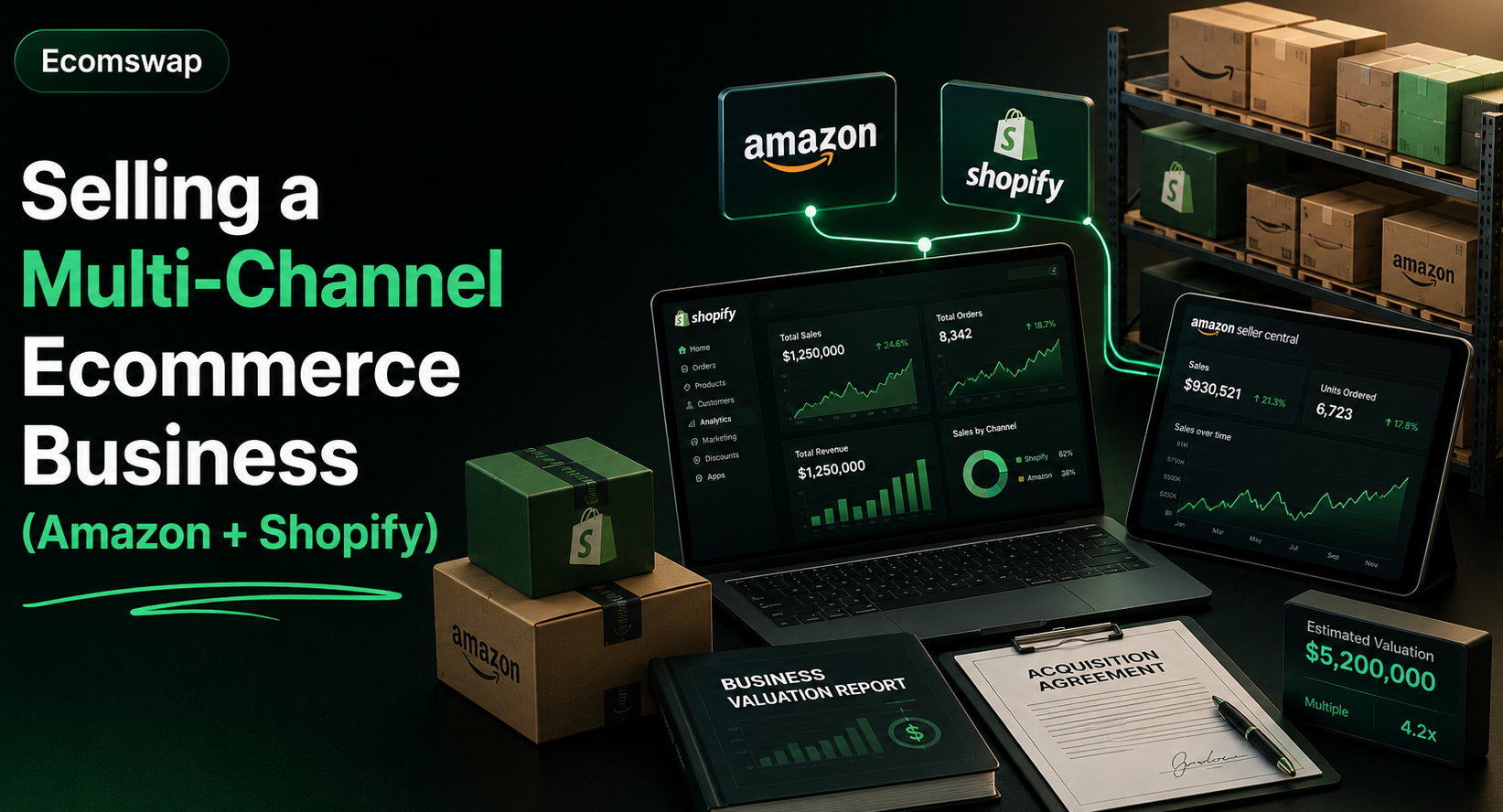
Multi-channel ecommerce businesses sell at a premium in 2026. The combination of Amazon FBA revenue and a Shopify DTC brand, when properly structured and documented, consistently outperforms single-channel businesses at the negotiating table. The problem is that most founders who built across both channels built them independently, and that architecture creates complexity that buyers will examine in detail before closing. Understanding how buyers evaluate multi-channel businesses, and what you need to prepare before going to market, is the difference between a clean exit at a strong multiple and a six-month diligence process that ends in a repriced deal.
This guide covers everything founders need to know about selling a business that operates across both Amazon and Shopify, from how buyers model blended revenue to the specific documentation issues that most commonly delay or reduce multi-channel deals.
If you are coming to this from an FBA-first perspective, the foundational guide is How to Sell an Amazon FBA Business in 2026. For Shopify and DTC sellers new to how multiples work across channels, DTC Brand Valuation: The 7 Factors That Move Your Multiple Up or Down covers the valuation mechanics in depth.
Why Multi-Channel Businesses Trade at a Premium
The fundamental reason multi-channel businesses attract strong buyer interest is diversification. A business that derives revenue from both Amazon and a direct Shopify channel has reduced its dependence on any single platform. Amazon account suspensions, algorithm shifts, and Buy Box loss events do not threaten 100% of revenue. Shopify-side performance volatility from Meta ad changes or iOS attribution disruptions does not threaten the Amazon revenue base.
From a buyer’s perspective, the risk profile of a multi-channel business is structurally lower than a single-channel business at the same SDE level, and that lower risk should theoretically translate into a higher multiple. In practice, it does, but only when the two channels are well documented, operationally distinct, and clearly profitable on a standalone basis.
The complexity of running both channels is also a competitive moat. A founder who has spent three to five years building and optimizing Amazon listings while simultaneously managing a Shopify brand, email list, and paid acquisition strategy has built something that is genuinely difficult to replicate. Buyers who understand ecommerce recognize that complexity as a barrier to entry, not just an operational headache.
Category 1: How Buyers Model Amazon vs. Shopify Revenue
The first thing serious buyers will do with a multi-channel business is decompose revenue and profitability by channel. They want to understand not just the blended P&L but how each channel performs on a standalone basis, and whether the profitability of the overall business is evenly distributed or concentrated in one channel that masks problems in the other.
What buyers examine:
- Revenue by channel for trailing 24 months (Amazon vs. Shopify, broken out monthly)
- COGS by channel, including Amazon referral fees, FBA fulfillment fees, and storage costs
- Gross margin by channel after all platform-level fees
- Contribution margin by channel after advertising spend
- SDE contribution from each channel (buyers will attempt to attribute fixed overhead proportionally)
- Growth trajectory comparison: is Amazon growing while Shopify declines, or vice versa?
- SKU overlap between channels: are the same products sold on both, and at what price difference?
The most common revenue modeling issue: a blended P&L that makes the business look more profitable than it is on either channel individually. If Amazon gross margins are 25% after fees and Shopify gross margins are 55%, the blended margin looks healthy, but a buyer modeling a channel-specific scenario quickly identifies that the Amazon business alone, at its actual margin structure, may support a different multiple than the overall blended figure suggests. Have a clean, channel-separated P&L ready before diligence begins.
Category 2: Amazon Account Health and Platform Risk
Amazon account health is a distinct due diligence category for multi-channel businesses. Buyers who acquire businesses with Amazon revenue need to understand the account’s historical compliance record, any policy violations, and whether there are performance metrics that create meaningful suspension risk after the acquisition.
What buyers examine:
- Seller Central account health dashboard: order defect rate, late shipment rate, pre-fulfillment cancellation rate
- Any past account suspensions, warnings, or policy flags (including ASIN-level violations)
- Intellectual property complaints filed against the account and their resolution status
- Review health: verified review acquisition practices, any history of review manipulation warnings
- Listing status for top-revenue ASINs: are any at risk of suppression or category restrictions?
- FBA inventory age and any slow-moving or stranded inventory with associated storage fees
- Amazon Brand Registry status and trademark registration coverage
- Any pending or open A-to-Z claims or chargeback history
The single most common Amazon diligence issue: undisclosed account warnings that the seller has normalized but that buyers treat as material risk. If your account received a policy violation notice three years ago that you successfully appealed, that history is still visible to buyers in Seller Central. Disclose it proactively with the resolution context. An undisclosed issue discovered in diligence is treated with far more suspicion than one disclosed upfront.
Category 3: Shopify Brand and Customer Asset Valuation
The Shopify side of a multi-channel business carries a different set of valuation assets than the Amazon side. Amazon revenue is largely tied to listing authority, keyword rank, and account health. Shopify revenue is tied to brand equity, owned customer relationships, email list quality, and paid acquisition efficiency. Buyers value these differently and will assess them separately.
What buyers examine:
- Shopify revenue breakdown by source: paid social, email flows, organic/SEO, repeat purchase
- Email list size, health metrics (open rate, unsubscribe rate), and Klaviyo flow attribution
- Customer lifetime value at 12 and 24 months
- Repeat purchase rate and cohort retention curves
- AOV trend over 12 months and any seasonality patterns
- Paid advertising efficiency: Meta and Google ROAS over trailing 12 months, CAC by channel
- Google Search Console traffic for organic channel health
- Brand recognition signals: search volume for brand name, social following, press mentions
The Shopify brand assets, particularly the email list and repeat customer base, often represent the most compelling part of a multi-channel acquisition for strategic buyers. A buyer who already operates Amazon brands sees a Shopify DTC presence as a customer acquisition and loyalty mechanism they do not have. Presenting your Klaviyo data cleanly, with flow attribution and cohort analysis, substantially strengthens this part of the diligence package. For more on how these customer metrics affect your overall valuation, see DTC Brand Valuation: The 7 Factors That Move Your Multiple Up or Down.

Category 4: Operational Integration and Transition Risk
Multi-channel businesses introduce operational complexity that single-channel businesses do not have. Buyers need to understand how the two channels interact at the inventory, fulfillment, and team level, and whether any of those integrations create dependencies that complicate the post-acquisition transition.
What buyers examine:
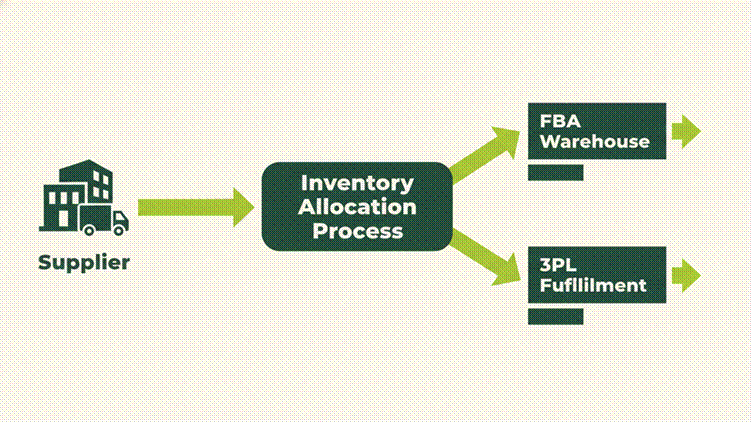
- Inventory sourcing: is inventory purchased for both channels from the same supplier, or separately?
- Fulfillment structure: does FBA handle Amazon exclusively, or does the seller use FBA for some Shopify orders as well (Multi-Channel Fulfillment)?
- 3PL or warehouse arrangements for Shopify fulfillment and their contract terms
- Inventory allocation process: how does the seller decide how much stock goes to FBA vs. Shopify?
- Systems and tools that bridge both channels: inventory management software, ERP or OMS
- Team structure: who manages Amazon vs. Shopify day-to-day, and are these the same people?
- Owner involvement: does the founder personally manage both channels, or has the Shopify side been delegated?
- Standard Operating Procedures for all key functions on both channels
The most common operational integration issue: inventory allocation managed entirely in the founder’s head with no documented process. Buyers who acquire multi-channel businesses need to replicate the inventory decision-making framework, and if that framework exists only as institutional knowledge, it creates transition risk that gets priced in. A documented inventory allocation policy, even a simple one, eliminates this concern entirely.
Category 5: Channel-Level Financial Due Diligence
Beyond the revenue decomposition in Category 1, buyers will conduct a channel-specific financial review that mirrors the full due diligence process for each channel individually. This is essentially two due diligence reviews conducted simultaneously, and founders who are not prepared for that scope are typically the ones whose diligence periods run longest.
What buyers examine:
- Amazon Seller Central financial reports: 24 months of settlement statements reconciled to bank deposits
- Shopify financial reports: 24 months of sales, refunds, and payout reconciliation
- Payment processor statements (Stripe, PayPal, Shopify Payments) reconciled to Shopify revenue
- Amazon advertising spend from Sponsored Products, Sponsored Brands, and Sponsored Display campaigns
- Shopify advertising spend from Meta and Google with campaign-level reporting
- Combined COGS documentation with supplier invoices covering both channels
- Returns and refund data by channel (Amazon return rate vs. Shopify return rate often differ significantly)
- Any Amazon reimbursements or credit adjustments that inflate reported revenue
The most common financial diligence issue in multi-channel businesses: settlement statement reconciliation failures on the Amazon side. Amazon pays out every two weeks and aggregates fees, reimbursements, and adjustments into a single settlement. If your bookkeeper has been recording Amazon payouts rather than Amazon net revenue, your P&L understates gross revenue and misrepresents your Amazon fee structure. Buyers will request settlement statement detail and reconcile it themselves, so having this done accurately in advance is critical. For a thorough overview of what the full financial diligence review looks like, see The DTC Due Diligence Checklist 2026.
Preparing Your Multi-Channel Business for Sale
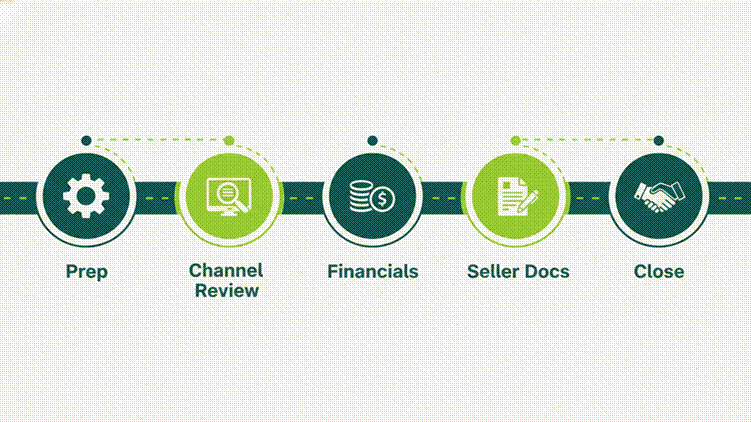
Selling a multi-channel business requires more preparation than selling a single-channel one, but the preparation translates directly into a faster close and a stronger final price. The following actions, taken six to twelve months before going to market, address the issues most likely to surface in diligence or reprice your deal.
What to document and resolve before going to market:
- Build a clean, channel-separated P&L for trailing 24 months with Amazon and Shopify revenue, COGS, and gross margin shown independently
- Reconcile Amazon settlement statements to bank deposits and ensure your P&L reflects gross revenue, not net payouts
- Review Amazon account health and resolve any open policy issues, A-to-Z claims, or stranded inventory
- Ensure Amazon Brand Registry is active and your trademark is registered (not just applied for) before going to market
- Export Klaviyo cohort data, flow attribution, and list health metrics and verify they tell a clean growth story
- Document your inventory allocation process, sourcing relationships, and fulfillment setup in writing
- Confirm that all accounts (Amazon Seller Central, Shopify, Meta Business Manager, Google Ads, domain registrar) are owned by a business entity, not a personal account
- Prepare a data room that includes channel-separated financials, Amazon Seller Central reports, Shopify analytics exports, advertising performance reports, supplier contracts, and SOPs for both channels
The biggest preparation mistake founders make with multi-channel businesses: treating them as one business when building the data room rather than two businesses that need independent documentation. Buyers will evaluate each channel separately, and a data room that only presents blended information requires buyers to do their own decomposition work. That adds time and creates uncertainty. Doing that work for buyers, and presenting it cleanly, is one of the most effective things you can do to protect your multiple and your timeline.
Understanding Blended Multiples for Multi-Channel Businesses
One question that comes up frequently in multi-channel sale conversations is how buyers determine the right multiple when two channels have structurally different multiple benchmarks. FBA businesses typically trade at 2.5x to 3.5x SDE depending on account health and growth profile. Shopify DTC brands with strong email lists and repeat purchase rates can trade at 3x to 5x SDE when the brand equity is demonstrably strong.
Buyers approach this in one of two ways. Some apply a blended multiple, weighting each channel’s contribution to total SDE and applying a channel-appropriate multiple to each contribution. Others apply a single multiple to total SDE, adjusted for the strategic value of the combined platform presence. In practice, the blended multiple approach tends to produce a number close to what the single multiple approach produces when the deal is priced correctly.
What shifts the multiple meaningfully in multi-channel deals is not the calculation methodology but the underlying quality of each channel. A business where both channels are growing, both have clean account health, and both have strong documentation for the metrics buyers care about will trade at the high end of its range regardless of methodology. A business where one channel is declining and the other is masking it will trade at a discount regardless of how the blended calculation is structured.
For current market data on where multiples are trading across channel types, see Ecommerce Multiples in 2026: Real Deal Data from EcomSwap.
Bottom Line
Multi-channel ecommerce businesses represent some of the most attractive acquisition targets in the current market, but they require more preparation, more documentation, and more structured presentation than single-channel businesses to realize their full valuation potential. The founders who go to market with channel-separated financials, clean Amazon account health, documented operational systems for both channels, and a data room that addresses every category of buyer concern consistently close faster and at stronger multiples than those who present a blended picture and let buyers figure out the rest.
If you are running both Amazon FBA and Shopify and thinking about a sale in the next 12 to 24 months, the preparation work you do now will have a direct and measurable impact on your final outcome. EcomSwap works with multi-channel sellers from early preparation through close. The first step is understanding what your business is worth across both channels, and that starts with an honest assessment of how each channel contributes to your total SDE and how buyers will evaluate each one independently.