
The wire hits your account, the deal closes, and you assume your obligations are over. They are not. On most ecommerce deals the buyer cannot run the business the day after closing, because the Shopify admin is still tied to your login, the payment processor is still in your name, the supplier only answers your phone, and the ad accounts live inside your personal Business Manager. The document that bridges that gap is the transition services agreement, and it governs what you owe the buyer in the weeks and months after the sale. A seller who treats it as a closing formality can find themselves working unpaid for half a year. A seller who negotiates it deliberately defines exactly what they will do, for how long, and for what, and then walks away clean.
This guide explains what a transition services agreement is in an ecommerce sale, why these deals almost always require one, what services belong in the scope, how long the agreement should run and what it should pay, and the ecommerce-specific provisions that catch sellers off guard. It is written for founders of Shopify, DTC, Amazon FBA, and SaaS businesses heading into a sale. None of this is legal advice; use it to ask sharper questions of the attorney who papers your deal.
What a Transition Services Agreement Actually Is
A transition services agreement, almost always shortened to TSA, is a contract under which the seller continues to provide defined services to the buyer for a set period after the sale closes. It exists because ownership of a business changes hands in a single moment at closing, but the practical ability to operate that business cannot transfer that fast. The TSA fills the gap between legal ownership and operational control.
In large corporate deals, TSAs cover things like shared IT systems, payroll processing, and back-office functions that the buyer cannot stand up overnight. In ecommerce deals the same logic applies at a smaller scale. The buyer now owns the brand, the inventory, and the customer list, but they cannot yet log into the systems, talk to the suppliers as the principal, or run the ad accounts under their own credentials. The TSA is the seller’s promise to keep those things working while the buyer takes them over.
What separates a TSA from the rest of the purchase agreement is that it governs your conduct after the money has changed hands. The representations and warranties allocate risk for the past. The TSA allocates your time and effort for the future. That distinction matters because your leverage is highest before closing and drops sharply afterward, so the terms of the TSA need to be locked before you sign, not improvised once the buyer already owns the business.
What a TSA typically defines:
- The specific services the seller will continue to provide after closing
- The duration of each service and the overall term of the agreement
- The time commitment expected of the seller, in hours or availability
- Whether the services are paid, and if so at what rate
- The standard of performance the seller is held to
- How the agreement ends and what happens if either side falls short
The most common framing mistake: treating the TSA as a handshake that gets sorted out after closing. The TSA is a binding contract, and its terms decide whether your post-sale involvement is a defined two-week handoff or an open-ended obligation to be on call for months. Negotiate it with the same care as the price, because once the buyer owns the business your leverage to change it is gone.
The TSA is one piece of a larger handoff, and the broader operational and emotional reality of stepping away is covered in Post-Sale Transition: What Happens After You Sell, which sets the context for why the services period exists in the first place.
Why Ecommerce Deals Almost Always Need One
It is tempting to assume that a clean business with good documentation does not need a transition services agreement. In practice almost every ecommerce deal has one, because so much of what makes these businesses run is tied to the founder personally and cannot be reassigned with the stroke of a pen at closing. The TSA is what keeps revenue flowing while those personal threads get rewoven to the buyer.
The clearest example is platform accounts. A Shopify store, an Amazon Seller Central account, a Klaviyo instance, and a Meta Business Manager are all tied to credentials, and several of them have their own transfer processes that take days or weeks and sometimes require the original owner’s cooperation to complete. During that window the seller has to remain involved, because pulling access too early can freeze payouts, interrupt advertising, or in the worst case trigger a platform review. The Amazon account transfer in particular is its own process, covered in How to Transfer an Amazon Seller Central Account in a Sale, and it is one of the most common reasons an FBA deal needs a structured services period.
Supplier and vendor relationships are the second driver. Many ecommerce founders have years of goodwill with a manufacturer that exists nowhere in writing. The buyer needs warm introductions, and suppliers often want to hear directly from the departing founder that the new owner is to be trusted. That cannot happen at the closing table; it happens over the following weeks, and the TSA is what obligates the seller to make those introductions properly.
Why ecommerce deals lean on a TSA:
- Platform accounts that take days or weeks to transfer and need seller cooperation
- Payment processor and merchant accounts that cannot be reassigned instantly
- Supplier and 3PL relationships that depend on a personal introduction
- Ad accounts and pixel history tied to the founder’s profiles
- Tribal knowledge about products, seasonality, and customers that lives only in the founder’s head
- Customer service nuance and brand voice that takes time to hand over
The most common seller assumption that backfires: believing that a well-documented business needs no transition support. Documentation transfers facts, but it does not transfer relationships, platform access, or the judgment built over years of running the brand. Plan for a real transition period, because the buyer will require one and a refusal to provide it can stall or kill a deal.

What Belongs in the Scope of Services
The single most important part of a transition services agreement is the scope, because it draws the line between what you owe and what you do not. A vague scope is the seller’s enemy. When the agreement says you will provide reasonable assistance with the transition, you have signed an open-ended obligation that the buyer can interpret broadly for as long as the term runs. A precise scope, listing each service and its boundary, is what lets you finish and leave.
The discipline is to enumerate the specific tasks rather than describe a general willingness to help. Each service should name what it covers, roughly how much time it involves, and when it ends. This is not about being ungenerous. It is about both sides knowing what done looks like, so the buyer gets a reliable handoff and the seller is not pulled back indefinitely for tasks that were never meant to be their responsibility.
A well-drafted scope distinguishes between active services and availability. Active services are things you will do, such as transferring accounts, introducing suppliers, and training the buyer’s team. Availability is being reachable for questions, which is far lighter and should be capped at a defined number of hours per week and a defined number of weeks, after which it simply ends.
Services that commonly belong in scope:
- Transferring or assisting with transfer of all platform and ad accounts
- Introducing the buyer to suppliers, manufacturers, and the 3PL
- Handing over standard operating procedures and any undocumented processes
- Training the buyer or their team on daily operations and tools
- Supporting the migration of payment processing and merchant accounts
- A defined number of hours per week of availability for questions
- Assistance resolving any in-flight customer or supplier issues at closing
The most common scope mistake: agreeing to provide reasonable assistance with no further definition. The word reasonable is decided by whoever has more leverage, and after closing that is the buyer. List every service explicitly with its own time limit, so the agreement defines a finish line rather than an open door the buyer can keep walking through.
How Long a TSA Should Run and What It Costs
Duration is where seller and buyer interests pull hardest in opposite directions. The buyer wants the seller available for as long as possible to de-risk the handoff. The seller wants to be free to move on, both because they have other plans and because every week of obligation is a week of unpaid or underpaid work if the terms are not set well. The right term is long enough to genuinely transfer the business and no longer.
For most ecommerce deals the active transition runs thirty to ninety days. A straightforward Shopify or DTC business with clean documentation can often hand over in thirty to sixty days. A more complex operation, a multi-channel business, or an Amazon-heavy deal where account transfer is slow can justify sixty to ninety days. Beyond ninety days the arrangement starts to look less like a transition and more like employment, and if the buyer genuinely needs the founder that long, that is a different conversation about a consulting agreement or an earnout, not a TSA.
Compensation is the part sellers most often overlook. A short, light transition of a couple of weeks is frequently bundled into the purchase price and provided at no extra charge, and that is reasonable. Anything substantial, a full-time or near-full-time commitment for a month or more, should be paid, either as a monthly fee in the TSA or as a defined consulting rate for hours beyond a baseline. The mistake is to give away months of real work because the agreement never put a price on the seller’s time.
How to think about term and payment:
- Active transition typically runs thirty to ninety days depending on complexity
- A light availability tail can extend a few weeks beyond the active period
- Brief, low-effort handoffs are commonly included in the purchase price
- Substantial time commitments should carry a monthly fee or hourly rate
- Hours beyond an agreed baseline should bill at a defined consulting rate
- Anything past ninety days should be structured as consulting, not a TSA
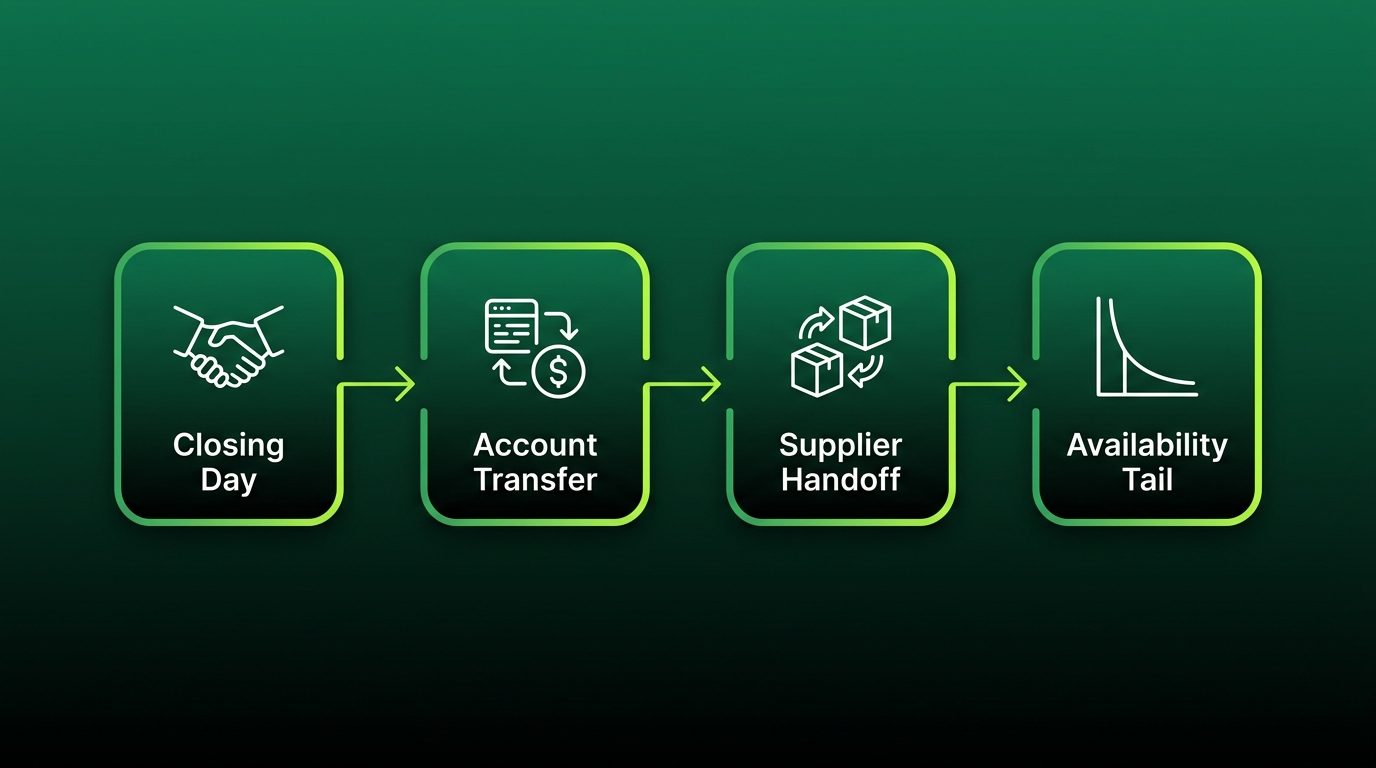
The most common duration and cost mistake: agreeing to be available with no end date and no fee. Open-ended availability with no payment is how a one-month handoff becomes six months of answering calls for free. Set a firm end date for active services, cap the availability tail, and attach a rate to anything beyond a light commitment.
For deals where the buyer wants the founder involved well beyond a normal transition, that ongoing role is often better handled inside the deal structure itself, and Earnouts in Ecommerce M&A: Pros and Cons explains how extended founder involvement gets priced and paid when it goes past a simple handoff.
Performance, Liability, and How the Agreement Ends
Once scope and duration are set, the TSA still has to define how well you have to perform, what you are on the hook for if something goes wrong, and how the agreement comes to a close. These provisions decide your exposure during the transition, and they are easy to skim past because they read like standard contract language right up until they are invoked.
The performance standard is the first to watch. A TSA should hold the seller to a reasonable standard of care, meaning you provide the services competently and in good faith, the same way you ran the business. What you want to avoid is a standard that makes you a guarantor of the buyer’s results. You are transferring a business and supporting the handoff. You are not promising that the business will hit any particular revenue number under new ownership, and the agreement should not let a post-closing downturn become your liability.
Liability and indemnity in the TSA should be narrow and capped. Your potential exposure for the transition services should be limited, ideally to the fees paid under the TSA itself, and it should exclude the kind of consequential or business-loss damages that could otherwise dwarf anything you earned for the work. This keeps a minor transition hiccup from turning into a major claim. The termination provisions then define the clean exit: the agreement should end automatically at the term, allow you to exit once defined milestones are met, and spell out what, if anything, survives.
What to pin down on performance and exit:
- A reasonable standard of care, not a guarantee of the buyer’s results
- Liability capped at the fees paid under the TSA where possible
- Exclusion of consequential, indirect, and lost-profit damages
- Clear completion milestones that allow early, clean termination
- Automatic expiry at the end of the term with no auto-renewal
- A defined process if the buyer claims services were not delivered
The most common liability mistake: signing a TSA whose indemnity and performance language mirror the purchase agreement’s. The transition is a small, time-limited service, and its liability should be small and time-limited too. Cap your exposure to the TSA fees, exclude business-loss damages, and make sure a slow handoff cannot be reframed as a breach with purchase-price-sized consequences.
Ecommerce-Specific TSA Provisions That Trip Sellers Up
Beyond the standard structure, ecommerce transitions carry a few provisions that catch sellers specifically, because the risk hides in the mechanics of how these businesses actually transfer. Platform access, financial flows, and personal accounts all create transition traps that a generic TSA template will not address.
Account access and the order of operations is the first. There is a real tension between handing the buyer access early enough to learn the business and keeping enough control to protect payouts and account health until the transfer is formally complete. A good TSA sequences this carefully: it specifies when admin access is granted, when ownership formally transfers, and how the seller is protected from liability for what the buyer does with the accounts during the overlap. Granting full control before the legal transfer is complete, with no protective language, is how sellers end up exposed for a buyer’s mistakes.
Money in transit is the second trap. At closing there will be funds still moving through the system: Shopify and processor payouts on a delay, Amazon disbursements on their own schedule, refunds and chargebacks landing after the cutoff, and inventory in transit. The TSA, alongside the closing mechanics, needs to say clearly who owns which dollar and who handles a chargeback that arrives three weeks after the sale. These details are part of the closing framework as well, and Closing the Deal: Ecommerce Sale Closing Checklist covers how the final handoff items get tracked so nothing falls between the two agreements.
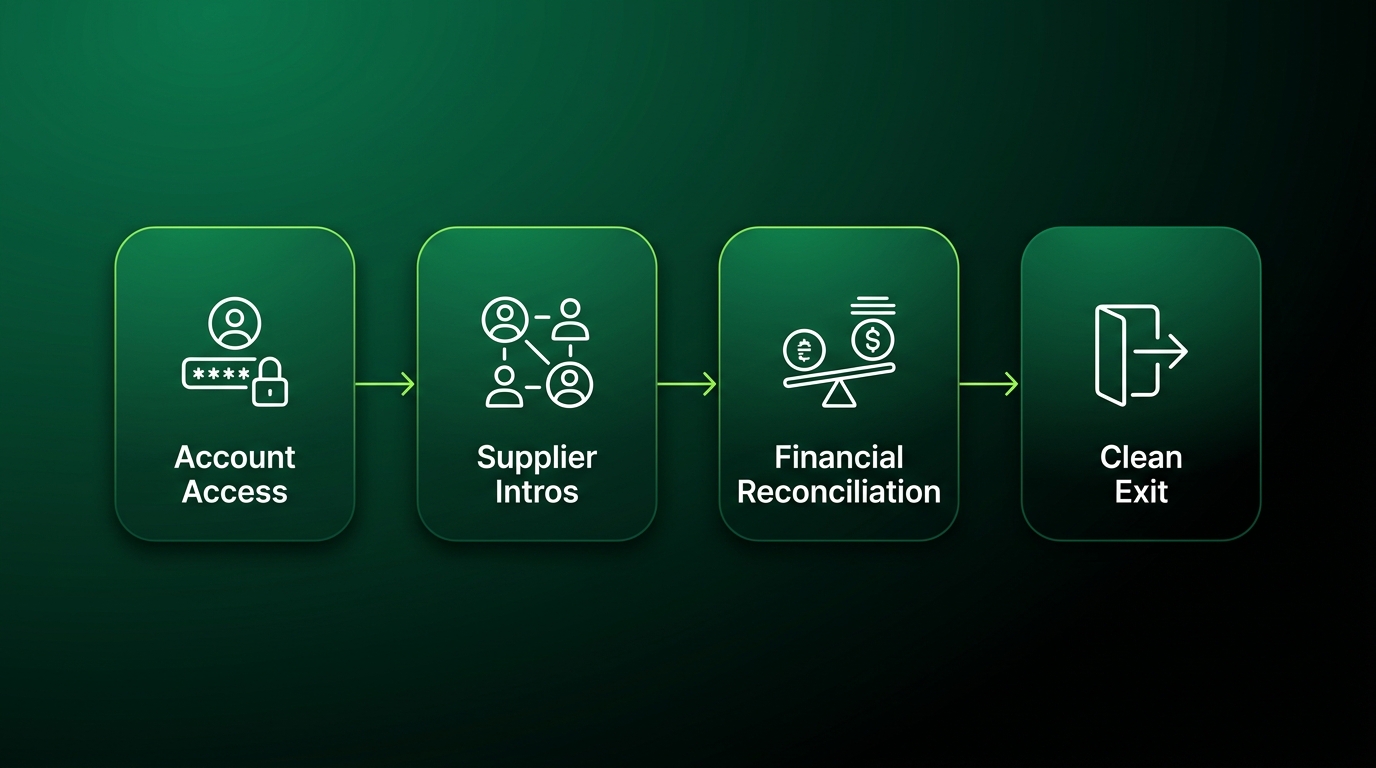
Personal accounts and identity are the third. Many founders have ad accounts tied to a personal Facebook profile, a domain registered to a personal email, and a payment processor in their own legal name. Some of these cannot be transferred and must be rebuilt, and the TSA should make clear that the seller’s obligation is to assist the buyer in standing up their own accounts, not to leave personal accounts running indefinitely under the buyer’s control. Leaving your name on a merchant account or your profile on an ad account after the transition is a personal liability you do not want lingering.
The ecommerce provisions to read most carefully:
- The sequence and timing of account access versus formal ownership transfer
- Protection from liability for the buyer’s actions during any access overlap
- Allocation of payouts, disbursements, refunds, and chargebacks in transit
- Responsibility for inventory and orders in process at the cutoff
- A clear plan to move off personal ad, domain, and processor accounts
- Confirmation that the seller’s personal identity is removed from all accounts at exit
The most common ecommerce TSA mistake: leaving personal accounts and identity attached to the business after the transition ends. A merchant account in your name or an ad account on your personal profile can create liability long after you have left, from chargebacks to policy actions. Make removal of your personal identity from every account an explicit completion milestone, not an afterthought.
Bottom Line
A transition services agreement is the contract that governs your life after the sale closes, and on an ecommerce deal it is almost never optional. The business changed hands in a moment, but the accounts, the suppliers, the ad history, and the institutional knowledge transfer over weeks, and the TSA is what obligates you to make that handoff work. Treated as a formality, it can quietly commit you to months of unpaid, open-ended availability. Treated as the contract it is, it defines a clean, bounded, fairly compensated exit.
The sellers who get this right do four things. They define the scope precisely, listing each service with its own time limit rather than promising reasonable assistance. They cap the duration, keeping active transition inside thirty to ninety days and attaching a fee to anything substantial. They limit their liability, capping exposure to the TSA fees and excluding business-loss damages. And they sequence the ecommerce mechanics carefully, protecting themselves during the access overlap and stripping their personal identity from every account before they walk away.
Get those right and the TSA does what it is meant to do: it gives the buyer a reliable handoff and gives you a defined finish line. Set the context with Post-Sale Transition: What Happens After You Sell, then make sure the handoff items are tracked against the Closing the Deal: Ecommerce Sale Closing Checklist so your transition ends exactly when the agreement says it does.