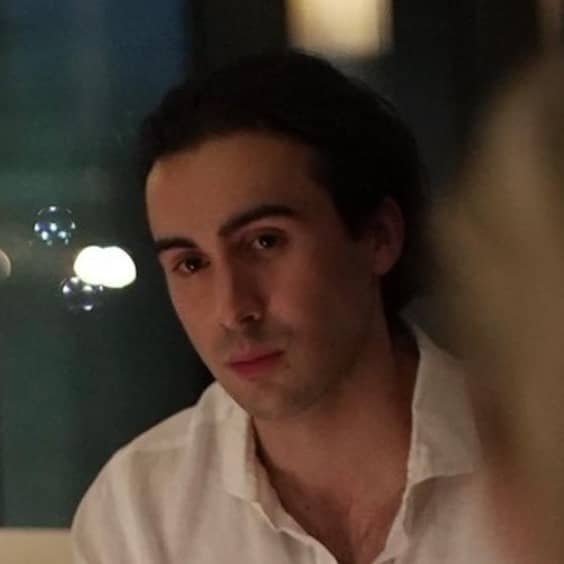
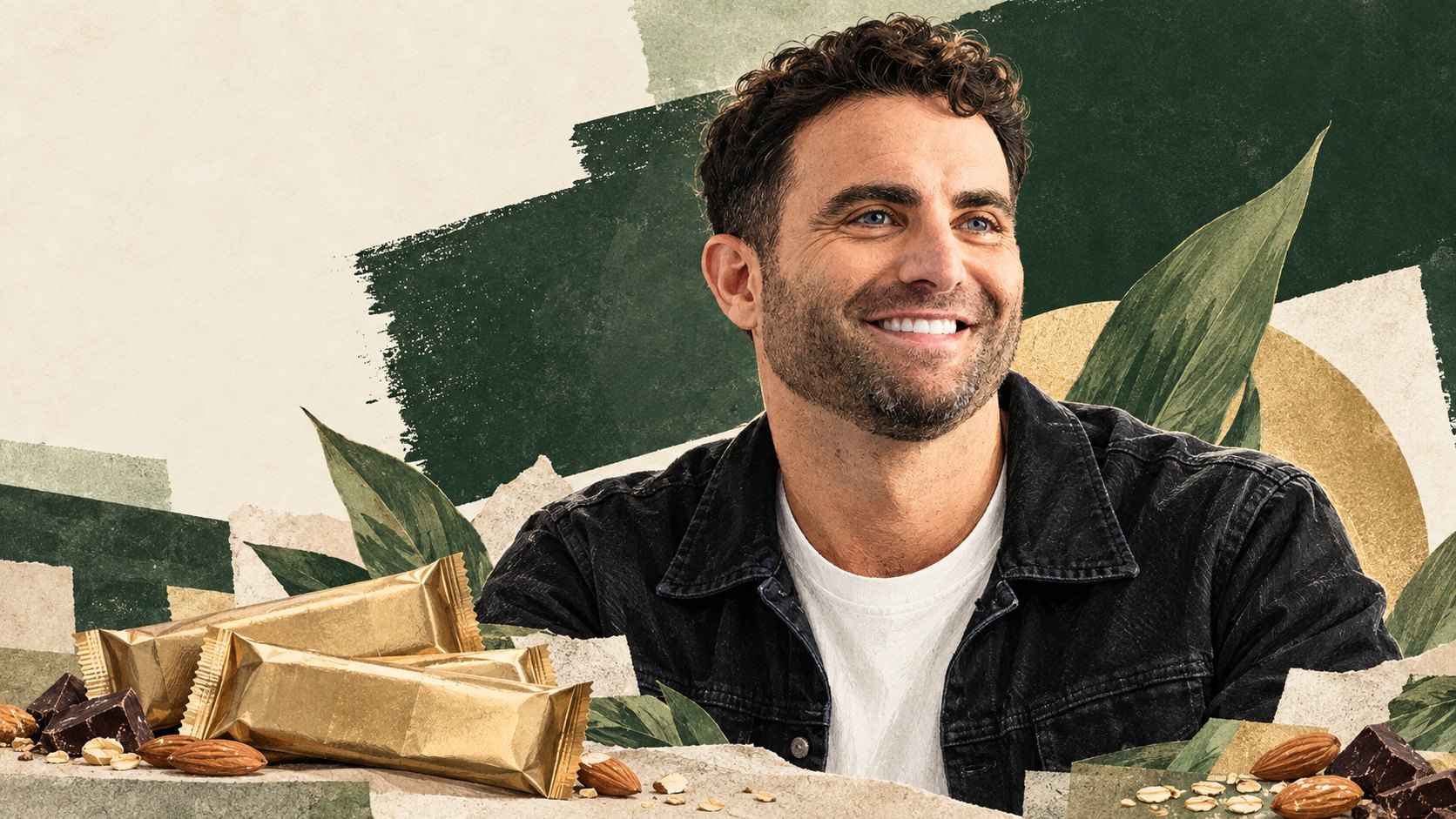
Peter Rahal has already had the exit most founders spend a career chasing. In 2017, Kellogg paid $600 million for RXBAR, the protein bar he started with a childhood friend in his parents’ home. Nine years later, his second act has made him a billionaire.
Forbes now estimates Rahal’s net worth at $1.9 billion. The jump follows a $250 million Series B for Medici Brands, the parent company of David Protein and the candy brand HallPass, at a $2.25 billion valuation. Forbes estimates he owns roughly 70% of the company and put another $20 million of his own money into the round. Those are estimates of paper wealth, not a cash payout.
Medici announced the round on September 2. Existing investors Greenoaks and Valor Equity Partners led it, with Rahal, ICONIQ and Imaginary Ventures joining.
The RxBar founder Peter Rahal’ Medici Brands, which owns David protein bars and better-for-you candy HallPass, raised $250 million at a $2.25 billion valuation in the biggest food deal of the year.
— Forbes (@Forbes) September 28, 2026
Read more: https://t.co/eLKeX1V8oA
📸: Aleksandr Karnyukhin for Forbes pic.twitter.com/YjaD3ldkNw
For anyone building or buying a consumer brand, the story is worth more than the headline number. Rahal has already done what most founders only attempt once: take a small brand all the way to a strategic acquisition. Now he is attempting something bigger, a house of brands sitting on top of its own ingredient supply. That structure has more moving parts, and more to prove.
It started with 100 bars and a PowerPoint label
Long before the institutional money, Rahal and his childhood friend Jared Smith were making bars at his parents’ home. Rahal has described the first run on The Failure Factor: a batch of 100, labels designed in PowerPoint and printed at FedEx Kinko’s, each bar packed by hand and driven to a local CrossFit gym and convenience stores in Chicago.
Those first sales paid for a bigger batch. As production grew, the pair moved into a small rented space and used a pizza dough roller to help make the bars. The early problem wasn’t demand. It was making enough to keep up.
That makes for a more useful origin story than the usual overnight-success version. They had a product they could actually make, a specific community to sell it to, and early sales that funded the next run. National distribution came later.
The wrapper that did the selling
A product that makes perfect sense to its first customers can still confuse everyone else. RXBAR’s fix was its packaging. In a 2018 Taste Radio interview, Rahal explained that describing the ingredients is what helped people understand the bar, so the redesign put that explanation right on the front of the pack.
The wrapper started doing the job a founder or gym owner used to do in person: giving a stranger a concrete reason to pick it up.
By October 2017 it was working well enough to attract Kellogg. Kellogg’s announcement pointed to RXBAR’s growth and profitability, and said the brand would keep running as a standalone business with access to Kellogg’s resources. In a few years, a business making small batches had become a brand a major food company wanted in its portfolio.
Round two: the “literal opposite” of RXBAR
After the sale, Rahal had capital and time. According to Forbes, a five-year noncompete kept him out of the category, so he set up his family office, Litani, in the meantime. He later co-founded David with Zach Ranen.
David flips RXBAR’s pitch. Where RXBAR sold simple, familiar ingredients, David leads with the numbers: its flagship bar has 28 grams of protein, 150 calories and zero sugar. Speaking to Nosh before the launch, Rahal called the two brands “literal opposites.”
“Literal opposites.”
Peter Rahal on RXBAR and David
He also chose to start online. Selling direct, he said, would let David talk to customers, understand demand and plan its move into retail. Both brands gave shoppers something specific to judge. They just appealed to different priorities.
From online launch to 35,000+ stores in two years
David launched in September 2024. By May 2025 it was in more than 3,000 US stores and had raised a $75 million Series A for manufacturing, inventory and product development. It also said it was on pace for more than $100 million in first-year revenue, which was a projection at the time.
By September 2026, Medici said David was available in more than 35,000 locations, including Walmart, Target and Costco, and had expanded into frozen dessert and ready-to-drink shakes.
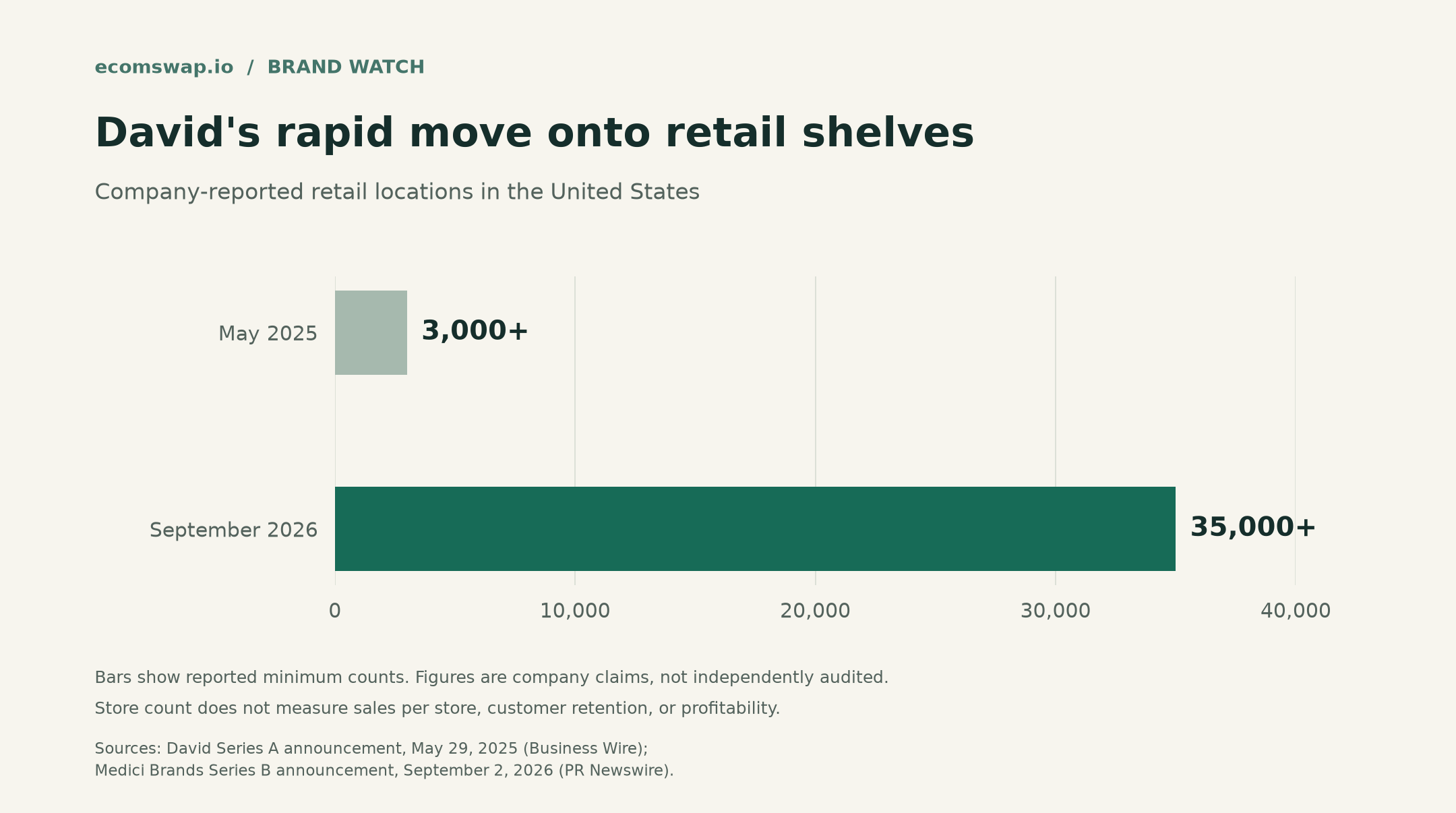
Company-reported store counts. Bars show the stated minimums, not exact totals.
A store count measures reach, not health. It can’t show whether each shelf earns its place, or how much profit those sales produce. For online brands moving into wholesale, that is the real test. Getting stocked is the opportunity; reorders, retailer payment terms and the cost of keeping inventory available decide whether it becomes a business.
Buying the supplier
Alongside the Series A, David bought Epogee, the company behind the fat alternative EPG. Rahal told AgFunderNews that David already accounted for about 90% of Epogee’s revenue, and that the deal was about securing enough of the ingredient to support its growth.
It also made David responsible for a supplier that other food makers depended on. By April 2026, Rahal said EPG manufacturing capacity had increased fivefold and that the business was in talks with larger food companies about supply. At that point, it had not sold EPG to outside customers since the acquisition.
An ingredient that works across many products could support more brands and new supply deals. Whether it does depends on execution. Owning the supplier doesn’t guarantee that every new use becomes a successful product.
The ingredient deal also brought a legal fight
Three food businesses, OWN Your Hunger, Lighten Up Foods and Defiant Foods, alleged that the acquisition and the loss of access to EPG harmed competition. David disputes the claims, arguing that alternatives exist and that it had no obligation to supply companies without long-term contracts, AgFunderNews reported.
The case is not settled in the court records we reviewed. Judge Victor Marrero dismissed the second amended complaint on February 4, 2026, then allowed the plaintiffs to amend it on March 17. A June 1 order noted that a further motion to dismiss was fully briefed, without ruling on it. The competitors’ claims remain allegations.
For buyers, it’s a useful reminder: dependence on a single supplier deserves as much diligence as revenue and margins.
HallPass: the “Coke Zero of candy”
The next bet is already on shelves. HallPass, founded by Rahal and Michael Tierney, launched nationwide at Walmart and online in late August 2026. Its first products are Peanut Cups, Peanut Creme Crispy Wafers and Chocolatey Candy Pieces, each marketed at 70 calories and one gram of sugar per serving, and priced alongside regular candy.
Building the Coke Zero of candy
— Peter Rahal (@PeterRahal) August 10, 2026
On August 29, HallPass hits Walmart shelves nationwide.
Sign up for product and launch updates at https://t.co/sLZRBAPI2I. pic.twitter.com/bjwZDNzuWj
The proposition is simple: a familiar treat with fewer calories and less sugar, without the premium price usually attached to that positioning. The real signal will be repeat purchases. Candy is a fresh test of taste, price and loyalty, and success in protein bars doesn’t settle it.
Medici also plans to launch another consumer brand, Rowdy, later in 2026.
A $2.25 billion valuation is not a $2.25 billion exit
The Medici number makes a great headline, but it is a different kind of number from RXBAR’s $600 million. One is what investors agreed the company was worth in a funding round. The other is what a buyer actually paid.
Kellogg’s 2017 announcement shows why the details matter. It disclosed a $600 million price, approximately $400 million after tax benefits, and forecast roughly $120 million in 2017 net sales. Run those numbers and you get two very different multiples:
| RXBAR calculation | Multiple |
|---|---|
| Headline price ÷ forecast 2017 sales | 5.0× |
| Cost after tax benefits ÷ forecast 2017 sales | ~3.3× |
Ecomswap calculations using Kellogg’s October 2017 announcement. The lower figure reflects the buyer’s tax benefits; it is not a smaller amount paid to the sellers.
Medici says it is on track for more than $300 million in revenue in 2026. That is a forecast, not a completed year. Using either headline to price a smaller ecommerce business would ignore big differences in profitability, financing and risk, and would treat a multi-brand company as if it were a single storefront.
What happens next
The questions facing Medici are bigger than the ones David faced at launch. Can it sustain demand across a 35,000-store retail network? Will shoppers keep buying its newer products? Can owning Epogee become a lasting advantage while the company manages the obligations and disputes that come with it?
Rahal has already built one brand a major food company wanted to buy. Now he has the capital to try something broader. The real evidence will come after the funding headlines fade.
This feature draws on published interviews, company announcements, independent reporting and court records. Financial estimates, company projections and legal allegations are attributed to their sources. Ecomswap’s interpretation is editorial analysis.